Free printable
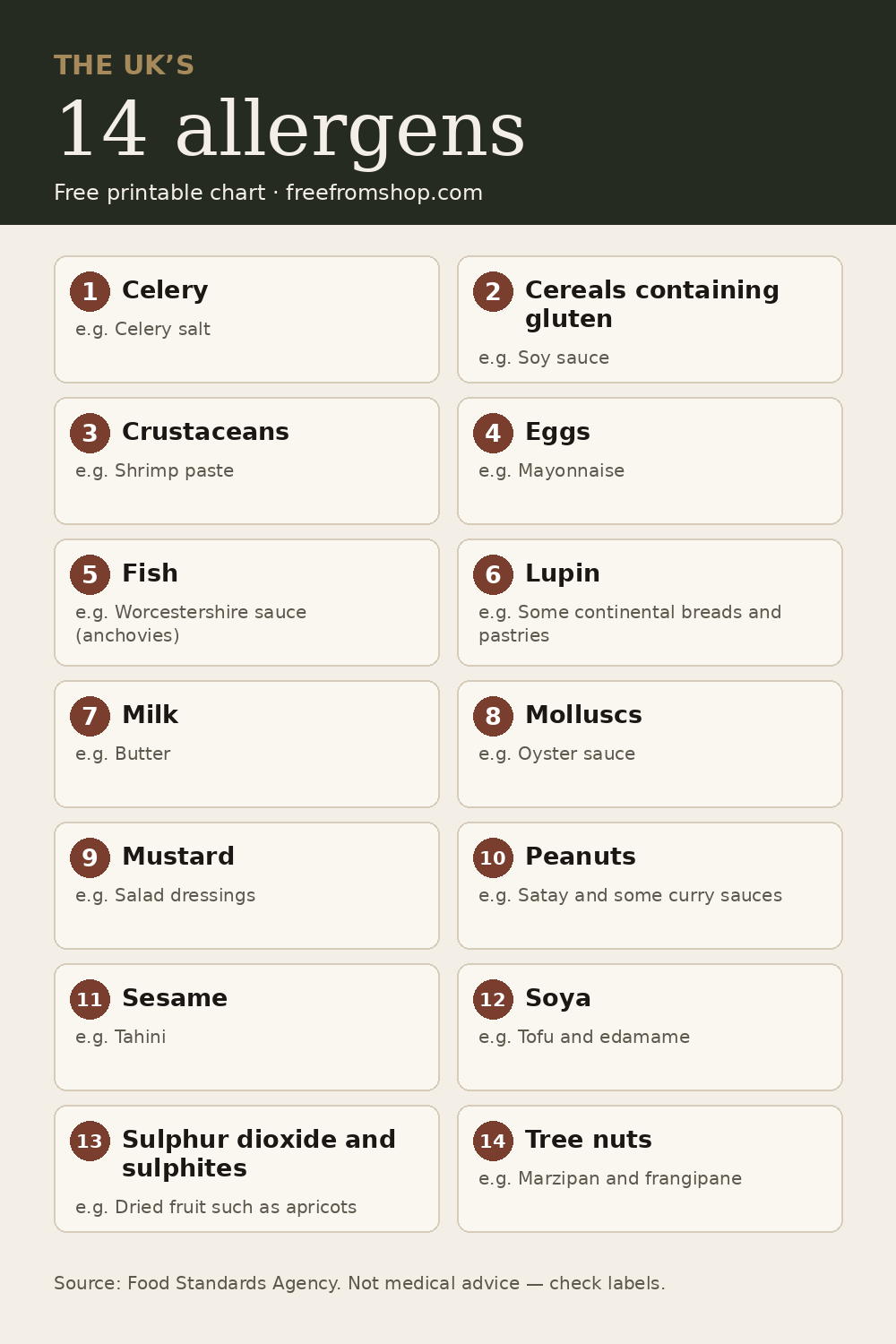
Download the 14 allergens chart
A one-page A4 chart for the fridge, the staff room or a school bag, plus a tall image for saving to Pinterest.
Why fourteen?
UK food law names fourteen allergens that food businesses must tell you about when they are used as an ingredient — including in additives, processing aids and anything else still present in the finished food. People can react to other foods too, but only these fourteen must be declared as allergens by law. That is the list the Food Standards Agency’s allergen guidance for food businesses sets out, and it applies in England, Wales and Northern Ireland.
On prepacked food, each allergen must be emphasised every time it appears in the ingredients list — usually in bold. When food is sold loose, in a café or from a takeaway, the business must still be able to give you the information, in writing or by telling you. Our guide to free-from labels explains the different rules.
The 14 allergens, one by one
Hidden sources are common examples, not a complete list. Recipes change — always check the current label.
1Celery
- What it is
- Includes celery stalks, leaves and seeds, and celeriac.
- Common hidden sources
- Celery salt, stock cubes and gravies, soups, spice blends, some salads and pre-made sauces.
- On the label
- Look for celery, celeriac or celery seed in bold in the ingredients list.
2Cereals containing gluten
- What it is
- Wheat (including spelt and khorasan), rye, barley and oats.
- Common hidden sources
- Soy sauce, malt vinegar and barley malt extract, batter and breadcrumbs, stock cubes, sausages, beer.
- On the label
- The cereal itself is named and emphasised, for example wheat flour or spelt (wheat).
3Crustaceans
- What it is
- Prawns, crabs, lobsters, langoustines and similar shellfish.
- Common hidden sources
- Shrimp paste, some Thai and Malaysian curry pastes, fish sauces, seafood stocks.
- On the label
- Named as the crustacean, e.g. prawn or crab, emphasised in the ingredients.
4Eggs
- What it is
- Eggs from hens and other birds, in any form.
- Common hidden sources
- Mayonnaise, fresh pasta, glazes on pastry and bread, meringue, some sauces and cakes.
- On the label
- Emphasised as egg, including dried or pasteurised egg.
5Fish
- What it is
- All fish species.
- Common hidden sources
- Worcestershire sauce (anchovies), Caesar dressing, fish sauce, some relishes and pizzas.
- On the label
- Named and emphasised, e.g. anchovy or fish sauce.
6Lupin
- What it is
- A legume related to peanuts; its seeds are milled into flour.
- Common hidden sources
- Some continental breads and pastries, gluten-free flour blends, pasta.
- On the label
- Emphasised as lupin flour or lupin protein.
7Milk
- What it is
- Cows’ milk and milk from other animals, and anything made from it.
- Common hidden sources
- Butter, cheese and cream, whey and casein, ghee, milk powder in crisps, breads and ready meals.
- On the label
- Milk derivatives are linked back to milk, e.g. whey (milk) or butter.
8Molluscs
- What it is
- Mussels, oysters, squid, clams, scallops, cockles, whelks and snails.
- Common hidden sources
- Oyster sauce, some fish stews and seafood stocks.
- On the label
- Named and emphasised, e.g. oyster sauce or mussels.
9Mustard
- What it is
- Mustard seeds, powder, leaves and prepared mustard.
- Common hidden sources
- Salad dressings, mayonnaise, marinades, curries, sausages, chutneys.
- On the label
- Emphasised as mustard or mustard seed.
10Peanuts
- What it is
- A legume that grows underground, sometimes called groundnut.
- Common hidden sources
- Satay and some curry sauces, groundnut oil, cakes, biscuits and confectionery.
- On the label
- Emphasised as peanut or groundnut.
11Sesame
- What it is
- Sesame seeds and oil.
- Common hidden sources
- Tahini, hummus, halva, breadsticks and bagels, some oils and dressings.
- On the label
- Emphasised as sesame seeds, sesame oil or tahini (sesame).
12Soya
- What it is
- Soya beans (soybeans) and foods made from them.
- Common hidden sources
- Tofu and edamame, soy sauce and miso, soya flour and lecithin, many plant-based and processed foods.
- On the label
- Emphasised as soya, e.g. soya lecithin.
13Sulphur dioxide and sulphites
- What it is
- Preservatives; declared when above 10 mg per kg or per litre.
- Common hidden sources
- Dried fruit such as apricots, wine and beer, cordials, some sausages and burgers.
- On the label
- Emphasised as sulphur dioxide or sulphites, often with an E number.
14Tree nuts
- What it is
- Almonds, hazelnuts, walnuts, cashews, pecans, Brazil nuts, pistachios and macadamias.
- Common hidden sources
- Marzipan and frangipane, praline, pesto, nut oils, some breads, biscuits and cereals.
- On the label
- The specific nut is named, e.g. almond or hazelnut — not just “nuts”.
Going out?
Explaining an allergy in a busy kitchen is easier with something in writing. Our printable allergy chef cards cover eight common allergies in five languages.
Sources
- Food Standards Agency — Allergen guidance for food businesses (the 14 allergens; sulphites above ten parts per million).
- Food Standards Agency — Food allergy and intolerance advice for consumers.
- GOV.UK — Running a food business: allergies (sulphites above 10mg per kg or per litre).
- Coeliac UK — Gluten-free law (naming the cereal, including spelt and khorasan wheat).